
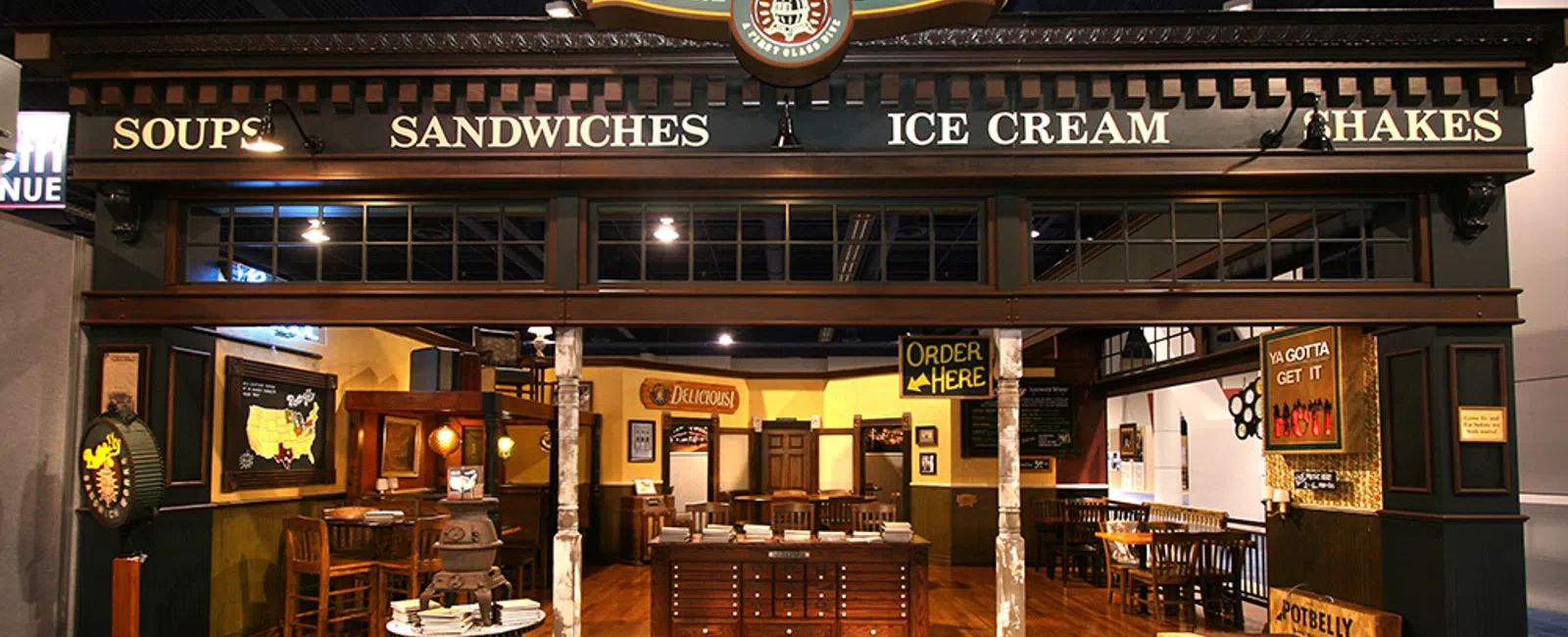
If there’s one shift worth calling out before you lock your 2027 show calendar, it’s this: the prettiest booth on the floor is no longer the one that wins.
We watched it happen all year. A booth that was also a lead machine. A booth that was also a product demo. A booth that was also a first handshake with a brand nobody in the aisle had heard of yet, each one built around a job, not a look. That’s the pattern. The exhibitors getting ahead stopped asking “how do we make this impressive?” and started asking “what is this space actually for?”
(Yes, we’re about to spend a whole piece arguing that gorgeous isn’t enough. For the record, we love gorgeous. Stick with us.)
A few things to keep in mind before we go further:
- This applies to anyone mapping out 2027 shows.
- We’re leaning on one real, receipts-attached example below.
- We are not anti-beautiful. Beautiful is welcome on the floor, it just can’t show up without a job.
What’s Changing in Trade Show Booth Design for 2027?
Booth design is moving from looks to results. For years, a great booth had one job: impact. Make it big, make it eye-catching, make people stop. Plenty of exhibitors nailed it and walked away with stunning photos and a crowded aisle.
The good news is that instinct for great design still matters. The catch is that it’s no longer enough on its own. Here is the difference we see between the two approaches:
| Factor | Appearance-First Booth | Performance-First Booth |
|---|---|---|
| Design starts with | The visual concept | The business objective |
| Primary goal | Look impressive, stop traffic | Hit a defined outcome (leads, demos, awareness) |
| How success is judged | Photos, foot traffic, “wow” factor | Qualified leads, demos booked, brand recall |
| After the show | Great photos, unclear ROI | Measurable results you can report |
Beautiful still helps. It just can’t be the whole strategy.
What Makes a Trade Show Booth Successful?
A booth performs when it communicates one clear message in about two seconds, guides visitors toward a single action, and was built against a goal you defined before design started. In practice, that looks like:
| Requirement | What It Looks Like on the Floor |
|---|---|
| Reads in ~2 seconds | A stranger grasps who you are and why it matters from the aisle |
| Guides to one action | The layout points visitors toward a single outcome you care about |
| Every element earns its keep | Nothing is there just to look nice |
| Success defined up front | The goal was written down before the first render |
Miss those, and even a beautiful custom exhibit can underperform a plainer one that knows exactly what it’s for.
What Does a Performance-First Booth Look Like? SpyCloud at RSAC 2026
A performance-first booth says one thing clearly instead of trying to say everything impressively. At the 2026 Beautiful Booth Awards, run by the Cybersecurity Marketing Society, SpyCloud took the sole win in the Long Booth category, and in a year when nearly every booth on that floor led with “AI,” SpyCloud deliberately didn’t.
| Approach | Typical RSAC 2026 Booth | SpyCloud (Category Winner) |
|---|---|---|
| Lead message | “AI”-forward, like everyone else | “Identity threat protection,” stated plainly |
| Strategy | Chase the buzzword | Name the real problem |
| Result | Blended into the crowd | Easy to find, easy to remember |
This isn’t a booth to copy. You’re probably not selling identity threat protection at RSAC, and RSAC is its own particular beast. But the discipline underneath it, say the real thing and resist the shiny thing, travels to any floor you’ll stand on in 2027. Which is the point we keep circling back to: beautiful is welcome but it has to pull its weight.
How Long Do You Have to Grab an Attendee’s Attention at a Trade Show?
About two seconds. That’s the window a passing attendee gives your booth before deciding whether you’re worth the stop. Nobody is studying your booth (well, maybe your competitors), but the people you actually want are walking past and deciding fast.
So your core message has to land at a glance. From the aisle, a total stranger should instantly grasp who you are and why it matters to them. Make them work a fourth or fifth second to “get” it, and you’ve already lost them to the booth next door no matter how gorgeous yours looks.
How Do You Design a Trade Show Booth Around Its Objective?
Start with the objective, then let it drive every decision. A booth built to capture leads should look nothing like one built to demo a product, which should look nothing like one built to introduce a name no one knows yet.
| Booth Objective | What the Booth Should Prioritize | How You Measure It |
|---|---|---|
| Lead generation | A clear qualifying hook, easy capture, open staff flow | Qualified leads and scans |
| Product demo & education | Room to show the product and gather an audience | Demos delivered, dwell time |
| Brand awareness (new name) | A bold, legible identity readable from the aisle | Recall, impressions, booth visits |
That is the why. The tactical how, translating your objective into a brief your designer can actually build from, is what our Creative Brief Guide walks through step by step.
Everything else is decoration. Stunning decoration, sometimes. But decoration.
Where Does Trade Show Booth Performance Actually Start? The Creative Brief
Performance starts in the creative brief, before a single concept is sketched. Your designer doesn’t add performance at the end, like a finishing coat. A booth simply can’t perform against a goal that was never written down. Here’s the difference between a brief that underperforms and one your exhibit house can build from:
| A Brief That Underperforms | A Brief Your Designer Can Build From |
|---|---|
| “Make it stand out” | “Book qualified demos with enterprise buyers” |
| Describes a look | Describes an outcome |
| No success metric | Defines what winning looks like |
| Designer aims for spectacle | Every decision has a purpose and a measure |
The smartest move for your 2027 program has nothing to do with renders or materials. It’s writing a brief your designer can build from, not around, and the exact fill-in-the-blank framework is in the template below.
The Bottom Line for Your 2027 Trade Show Program
Design each booth around a clear objective, and put that objective in the brief first. A showstopping exhibit still helps, but on its own, it won’t tell you whether the show was worth the spend. The exhibitors pulling ahead in 2027 built each booth around a goal, so the space kept earning its keep long after the aisles emptied.
So if you want your 2027 booth to perform, start where performance actually starts: on paper. Decide what the space is for, and put that answer in the brief before the first concept ever takes shape.
Start Where Performance Starts
Get the Creative Brief Template.
The fillable framework behind every high-performing booth, the exact template our designers wish every client filled out first. Define your objective, hand it over, and give every square foot a job.